
The Business Date Sales by Item Report answers how much of each item was sold and for how much on each business day. It sums the quantity, the amount and the VAT of the sales that match the filter, one row per item, and can split them by business day, location, user or partner. Open it from Reports → Business Date → Sales by Items….
It is the Sales by Items report counted by business day: a business day starts and ends at Business day start/end: in Tools → Settings… → Special (see The business day). With 04:00, a sale saved at 01:30 belongs to the business day before.
Filter
The Business Date Sales by Item Report window opens first. Fill in only the filters you need: an empty filter does not limit the report. Click OK to run the report. Clear empties the filters and sets the check boxes back to their default. The window keeps the last filter you ran.
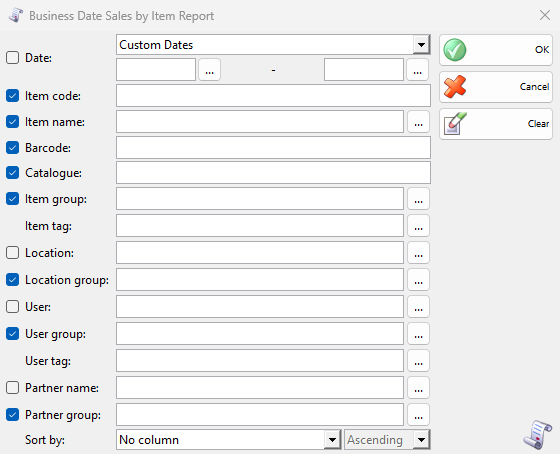
The check box in front of a filter puts its column in the result. A cleared check box also adds the rows up over that column: with Location: cleared, the sales of an item in all locations make one row. A text filter finds the values that contain the text. Press F4 or click … to choose from a list.
| Filter | What it limits | Column by default |
|---|---|---|
| Date: | The period, by business day. Choose a period from the list, where Today is the business day that is running now, or Custom Dates and a start and an end date. Without dates the report covers all sales. | Not shown |
| Item code:, Item name: | The items. | Shown |
| Barcode:, Catalogue: | The items by barcode or catalogue number. Each adds three columns. | Shown when the item window shows barcodes and catalogue numbers |
| Item group: | The items of a group. | Shown |
| Location:, Location group: | Where the sale was made. | Location group: only |
| User:, User group: | The user in the User field of the sale. | User group: only |
| Partner name:, Partner group: | The customer. | Partner group: only |
| Item tag:, Location tag:, User tag:, Partner tag: | Listed when such tags exist. They only filter. | No column |
| Lot:, Serial number:, Production date:, Expiration date:, Lot location: | Listed when you work with lots. A shown lot column splits the rows by lot. | Not shown |
| Sort by: | Sorts by Date, Code, Item, Location, Partner Name or User, ascending or descending. It sorts only by a column that is shown. | – |
Results
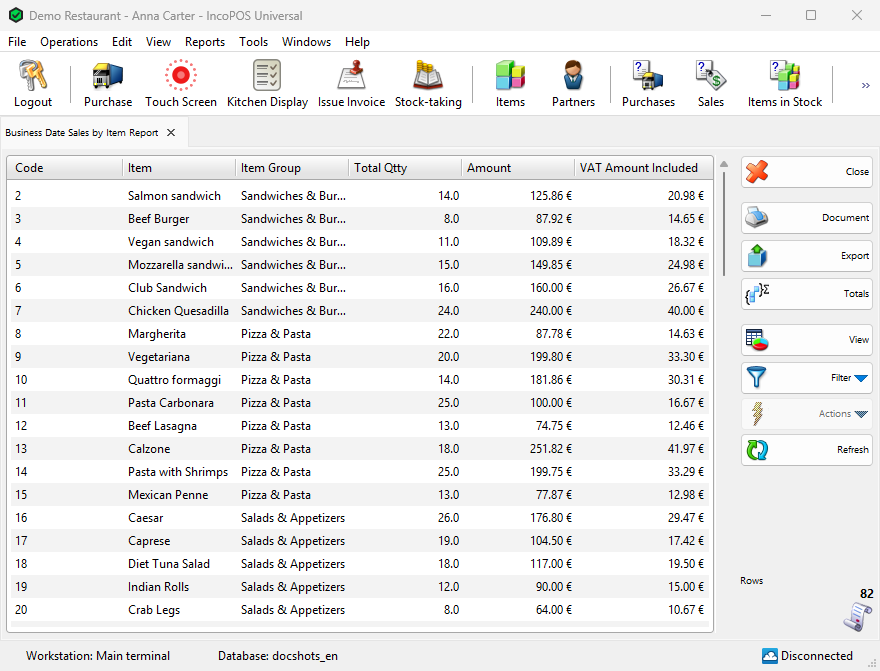
The result opens in its own tab. The example below has Barcode:, Catalogue: and the three group filters of locations, users and partners cleared, so each item has one row for all its sales.
| Column | What it shows |
|---|---|
| Date | The business day of the sales on the row. |
| Code, Item, Barcode 1 to 3, Catalogue 1 to 3, Item Group | The item, as it is now in Items. |
| Location, Location Group, User, User Group, Partner Name, Partner Group | Where, by whom and to whom the item was sold. |
| Total Qtty | The quantity sold, in the item’s Measure:. |
| Amount | The sum of quantity × price, after the discounts of the rows. |
| VAT Amount Included or VAT Amount | The VAT of these sales: part of Amount when prices include VAT, on top of it when they do not. |
How the numbers are counted
- The report counts saved sales from every sale window, for example Sale and Touch Screen, and Consignment Sale. Drafts and sales still pending in another database are left out. An annulled sale no longer exists, so it is not counted.
- Returns and credit notes are not subtracted. See the Returns report for them.
- A sale counts on the business day of the time its rows were saved, not on its Date. A sale saved today with an earlier Date counts today.
- Amount includes VAT when Use prices with included VAT is selected in Tools → Settings… → Special, and is without VAT when it is cleared. The VAT column is hidden when VAT registered is cleared there or all VAT groups are 0%.
- Amounts are in the main currency of the program. A sale made in another currency is counted at the rate saved with it.
- Item names, codes and groups come from the items as they are now, not as they were on the day of the sale.
Work with the results
Document opens the print preview of the result with its filters, and Export saves it to a file. Totals adds a row with the totals of Total Qtty, Amount and the VAT. View shows the result as bars or a pie (see View Report Results). Filter → Report Filter shows the filters next to the result and runs it again as you change them, Report Filter as New… opens the result of another filter in a new tab, and Quick Filter searches the text of the rows. Refresh runs the report again. The report can also be a panel of the Dashboard.
Double-click a row or use Actions → Edit to open its item. Actions → Transform Selected Items puts the selected items, with their Total Qtty, in a new document (see Transform Document). Actions → Print Selected Items prints their labels when a quick print setup of Print Barcodes exists.
Permissions
All permissions are set in Edit → Administration → Permissions….
| Permission | What it allows | Not allowed by default for |
|---|---|---|
| Reports → Business Date → Sales by Items… | The report. | Operators (the whole Reports menu) |
| Manage operators and view their operations | The sales of all users. Without it User: is fixed to your name. | Operators |
A user with a Locked partner: or Locked location: in the user’s settings gets that partner or location fixed in the filter.
FAQ
Why are the numbers different from Sales by Items?
Sales by Items counts a sale on its Date. This report counts it on the business day it was saved, so the sales after midnight and before Business day start/end: go to the day before, and a sale saved with an earlier Date counts on the day it was saved.
How do I see the sales of each business day?
Select the check box of Date:. Each business day gets its own row for each item.
Why is an item on several rows?
The rows differ in a shown column, often a group column of a location, user or partner. Clear the check boxes of the columns you do not need.