
The Cash Book lists the money that actually came in and went out, for all payment types, and shows the balance of any period and the current balance of each payment account. In it you also record income and expenses that have no document, transfer money between accounts and check the counted money against the expected amount. It is part of the paid Advanced Operations module.
Open the Cash Book
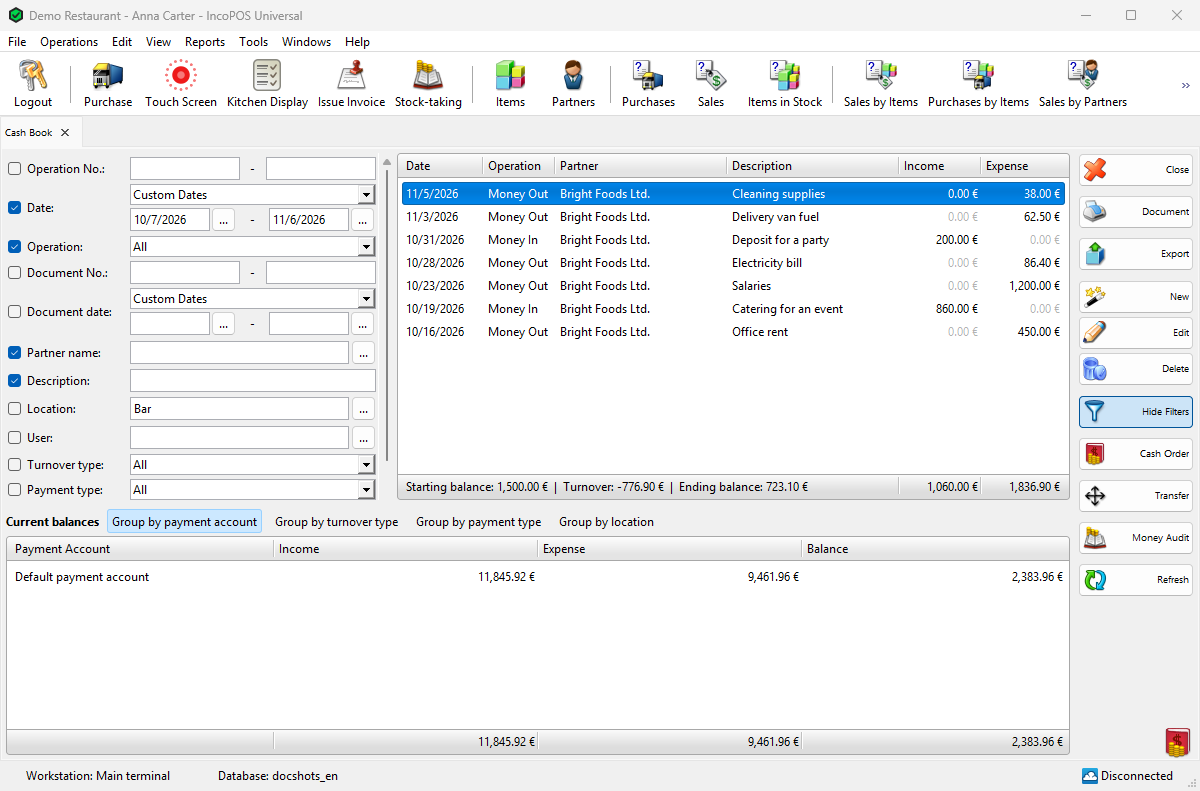
Go to Operations → Cash Book or press Shift+F11. The filters are on the left, the list is next to them, Current balances is under the list and the buttons are on the right.
Without a license for the module you can still view the Cash Book, but New, Edit, Delete, Cash Order, Transfer and Money Audit only show a message about the license.
What the list shows
Each row is one paid amount, with the newest first. Payments of sales, purchases and other documents appear on their own when they are saved, in the Payment window or in Payments. Amounts that are still due do not appear.
| Column | Meaning |
|---|---|
| Operation No., Operation | The number and the type of the operation, for example Sale, Purchase, Money In, Money Out or Money Audit. |
| Document No., Document Date | The number and the date of the invoice or other document of the operation. |
| Turnover Type | The purpose of the money. By default sales get Income (sale) and purchases get Expense (purchase). |
| Payment Type | How the money was paid. See Payment types. |
| Payment Account | The account that holds the money. Accounts are managed in Edit → Payments → Payment Accounts…. |
| Income, Expense | The amount, in the column of its direction. |
Filter the list
The list reloads as soon as you change a filter. The check box of a filter shows or hides its column. Document No., Document date:, Turnover type, Payment type and Payment account are hidden at first. The program remembers the filters and the columns for the next time.
In Date choose a period such as This Month or Past Month. The date fields are active only with Custom Dates, where you enter the first and the last date. Partner name, Description, Location and User find any part of the text. Hide Filters gives the list more room and Show Filters brings the filters back.
Balance of the list
The last line of the list shows the totals of Income and Expense and the balance of the rows.
| Value | Meaning |
|---|---|
| Starting balance | The money before the first date. Only the filters for partner, location, user, turnover type, payment type and payment account apply to it. Shown when Date has a first date. |
| Turnover | Income minus expense of the rows in the list. Shown together with Starting balance. |
| Ending balance | Starting balance plus Turnover. Without a first date it is the income minus the expense of the rows. |
Current balances
This table sums all payments up to now. The filters and the period above do not change it. Use the buttons to group it: Group by payment account (on by default), Group by turnover type, Group by payment type and Group by location. You can combine them, and each workstation remembers the choice. For each group the table shows Income, Expense and Balance.
Add an income or expense
Use this for money without a document, such as rent or a deposit into the cash desk.
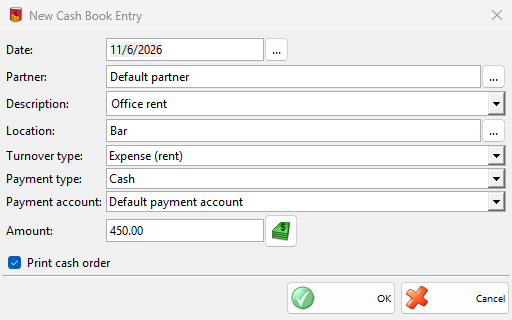
- Click New. The New Cash Book Entry window opens.
- Fill in the fields. In Date:, Partner: and Location: you can use F4, a double-click or the … button to choose.
- Click OK. The new row shows Money In or Money Out in the Operation column.
| Field | What to enter |
|---|---|
| Date: | Today is filled in. |
| Partner: | Required. The default partner is filled in. |
| Description: | Free text. The list offers the 10 most recent descriptions. |
| Location: | Required. It is filled in if your user has a default location or if there is only one. |
| Turnover type: | Decides if the amount is income or expense. The default types are Expense (purchase), Expense (consumption), Expense (salary), Expense (rent), Expense (fuel), Expense, Income (sale), Income (advance deposit), Income and Unknown. They are managed in Edit → Payments → Turnover Types…. Unknown is neither income nor expense, so new entries do not offer it, and an entry changed to it stays on its side. |
| Payment type: | Cash is selected by default. |
| Payment account: | The account of the money. |
| Amount: | Must be greater than zero. The button next to the field shows a panel with notes and coins. What you add there fills in the amount. |
| Print cash order | After saving, opens the cash order for the row. Not available with Unknown. Each workstation remembers the choice. |
Edit or delete a row
Select a row and click Edit, or double-click it. The Edit Cash Book Entry window has the same fields. To delete a row, select it, click Delete and confirm “Are you sure you want to delete this cash book entry?”. If the row belongs to a sale with a fiscal receipt, the question is “Are you sure you want to delete all payments of this operation?”: the receipt is annulled and all payments of the sale are deleted.
A row that belongs to a document, such as a sale or a purchase, keeps its partner and stays on its income or expense side. If the sale has a fiscal receipt, its amount cannot be changed either.
Both buttons follow Allowed operations modification: of your user. For an older row they show “You don’t have access to edit payments that far in the past!”.
Both work on every row, also on payments of sales and purchases. Changing or deleting such a row changes the paid amount of the document, and a deleted amount becomes due again.
Print a cash order
Select a row and click Cash Order. Income opens the Debit cash order and expense opens the Credit cash order. The button is inactive for a row with a turnover type based on Unknown.
Transfer money
Transfer moves money between locations, payment types or payment accounts, for example from the cash desk to the bank.
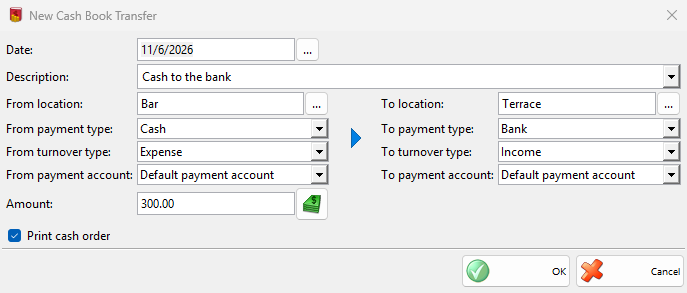
- Click Transfer. The New Cash Book Transfer window opens.
- Fill in the fields.
- Click OK.
| Field | What to enter |
|---|---|
| From location:, To location: | Both are required, and they can be the same location. |
| From payment type:, To payment type: | How the money is held on each side. |
| From payment account:, To payment account: | The account on each side. At least one of location, payment type and payment account must differ between the two sides. |
| From turnover type:, To turnover type: | The first offers only expense types and the second only income types. |
| Amount: | Greater than zero and not more than the balance of the source payment account and payment type. |
| Print cash order | After saving, opens a cash order for each of the two rows. |
The transfer saves two rows with the same Date:, Description: and amount: Money Out with the source values and Money In with the target values.
Money audit
Money Audit compares the money you counted with the amount the program expects and records the difference.
- Click Money Audit. The New Money Audit window opens.
- Choose Payment type: and Payment account:. Expected amount: shows their balance from all payments, in all locations.
- Enter the money in Counted amount: or use the panel with notes and coins. Difference in amount: shows the counted amount minus the expected one.
- Choose Location:, the location of the new row, and click OK.
- If there is a difference, answer Yes to “Are you sure you want to add a new payment for the difference between the counted and the expected amount?”.
The difference is saved as a row with Money Audit in the Operation column: income with the type Income if you counted more, expense with the type Expense if you counted less. If there is no difference, the window closes and nothing is saved.
Other buttons
| Button | What it does |
|---|---|
| Document | Opens the print preview of the list, with its balance and active filters, and then of Current balances. |
| Export | Saves the list and its balance to a file. |
| Refresh | Reloads the list and Current balances. |
| Close (Esc) | Closes the Cash Book. |
Permissions
Operators do not have the Cash Book by default. In Edit → Administration → Permissions… an administrator allows Cash Book (Operations) and, under it, New, Edit, Delete, Transfer and Money Audit. Cash Order needs Edit.
Payment Accounts View decides which accounts appear in the list, in Current balances when grouped by payment account and in the filter. Payment Accounts Use decides which accounts you can choose in the windows.
Troubleshooting
| Problem | Solution |
|---|---|
| “This is a free version of the Cash Book! …” | The action needs a license for the Advanced Operations module. |
| “Please select a partner.” or “Please select a location.” | Enter an existing name or choose from the list. |
| “Please select a source location.” or “Please select a destination location.” | In a transfer fill in From location: and To location:. |
| “Please select a valid amount.” | Enter an amount greater than zero. |
| “Locations, payment types and payment accounts cannot be the same for the source and the target!” | Change at least one of the three on one side of the transfer. |
| “The selected amount is more than the available balance.” | Lower the amount, or check the source payment type and payment account in Current balances with Group by payment account and Group by payment type on. |
| A payment is missing from the list | Check the filters, and ask an administrator if your user may view its payment account. |
FAQ
Does the Cash Book show only cash?
No, it shows all payment types. To see only cash, set the Payment type filter.
Why is a saved sale not in the Cash Book?
The sale is not paid yet. The row appears when a payment is saved for it.
Does a transfer change the total balance?
No. Its two rows have the same amount, so only the balances of the two sides change.
Related pages
- Credit cash order
- Debit cash order
- Payments section
- Payments reports