
A purchase records goods received from a supplier. Saving it increases the quantities in the selected location, updates the purchase and sale prices of the items and records what you paid or still owe to the supplier.
Open the Purchase window
Go to Operations → Purchase or press F3. Unless stated otherwise, the settings named on this page are in Tools → Settings… → Operations.
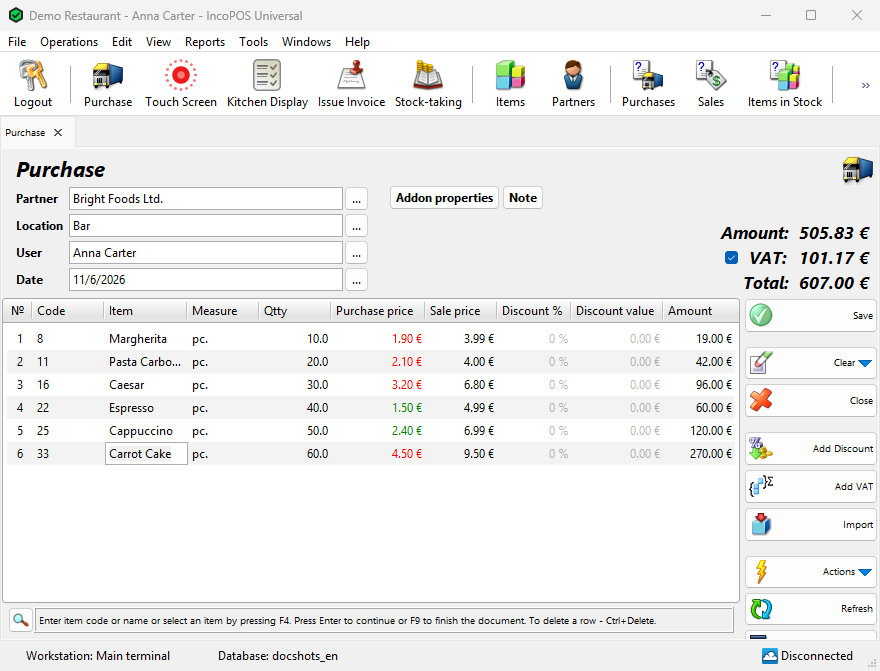
Fill in the header
In each header field type a name or code and press Enter, or open the list with F4, a double-click in the field or the … button.
| Field | What to enter |
|---|---|
| Partner | The supplier. This field is required. If the partner is VAT exempt, the document becomes VAT exempt too. |
| Location | The location that receives the goods. It is filled in if your user has a default location or if there is only one. |
| User | The logged-in user is filled in. Changing it requires the Edit User permission (Operations), which operators do not have by default. |
| Date | Today is filled in. Press F4 or double-click to pick a date from the calendar. Changing it requires the Edit Date permission (Operations), which operators do not have by default. |
Add items
- In the Item column type the item name, code or barcode and press Enter. To choose from the list, press F4 or double-click the cell. In the list you can select several items with Ctrl+click, or with Shift and the arrow keys, and create a new item with New.
- In the Qtty column enter the received quantity and press Enter.
- In the Purchase price column enter the supplier’s price and press Enter.
- In the Sale price column check or change the price and press Enter. A new row opens.
- Repeat for each item. To delete the current row press Ctrl+Delete.
When you enter a barcode, the row gets a quantity of 1 and the cursor moves to a new row. Entering the same barcode again increases the quantity of that row.
| Column | Meaning |
|---|---|
| Purchase price | The item’s current purchase price is filled in. With Use last purchase price by default in purchases, the price and the discount of the item’s last purchase are filled in instead. |
| Markup % | The profit as a percentage of the purchase price. Entering a value recalculates the sale price. Shown with Enable markup. |
| Sale price | The item’s price for the price group of the document. Sale price and Markup % are shown with the Show Sale Prices permission and can be changed with Edit Sale Prices In New Purchases (Operations → Purchase), which operators do not have by default. |
| Discount %, Discount value | A discount from the supplier for the row. Shown with Allow percent discounts or Allow value discounts. |
| Amount | Quantity × purchase price after the discount. With Enable totals edit you can enter the amount and the purchase price is recalculated. |
The totals Amount:, VAT: and Total: are shown at the top right. Clearing the check box next to VAT: makes the whole document VAT exempt after a confirmation.
Colors in the table
- Purchase price is red if it is higher than the item’s last purchase price and green if it is lower. The help line of the window shows both prices.
- Sale price is red if it is lower than the purchase price or the item’s current sale price, or if the item is in a promotion. It is green if it is higher than the current sale price.
- Item is orange if the same item is already on an earlier row. This is only a warning.
How a purchase changes stock and prices
When you save, the quantities increase in the selected location and the item’s purchase price is updated according to Item management:. If the row has a discount, the price after the discount is used.
| Item management | Purchase price after saving |
|---|---|
| Average price | The weighted average of the stock in all locations and the received quantity. |
| Average price per location | The same, plus a separate average for the selected location, which new rows use. |
| Last purchase price | The price from this purchase. |
| FIFO, LIFO, FEFO, Choice | The price from this purchase. The quantity is also kept as a lot with its own price. |
The Sale price of each row is saved to the item, in the partner’s price group, or in the location’s price group if the partner uses Retail price.
Price rules that apply to purchases can change the rows. The program then shows “Price rule applied”.
Lots
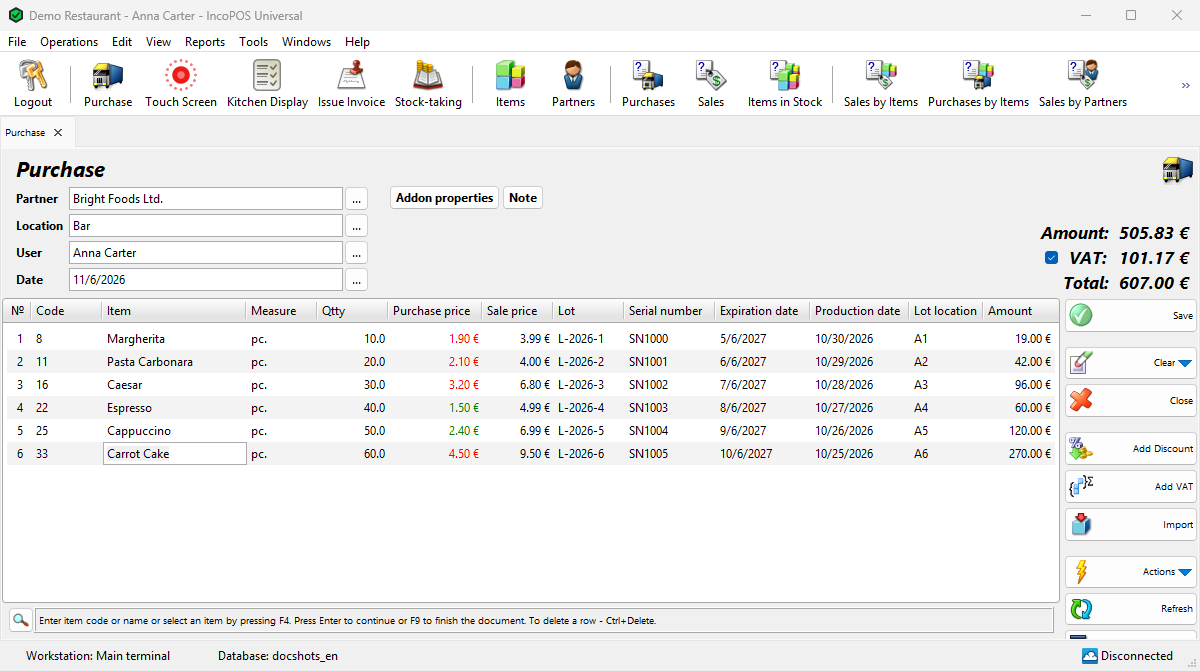
Lot columns appear only when Item management: uses lots (FIFO, LIFO, FEFO or Choice), each with its own setting: Enable lot name, Enable serial number, Enable expiration date, Enable manufactured date and Enable lot location. A purchase creates lots or adds to them and never asks you to choose an existing lot.
| Column | Meaning |
|---|---|
| Lot | The lot name. If you leave it empty, the row gets “NA”. |
| Serial number | On a new row with a quantity above 1, the program offers to split the row so that each unit gets its own number. |
| Expiration date, Production date | Press F4 or double-click to pick a date from the calendar. |
| Lot location | Free text for the place of the lot in the warehouse. |
Transport and other charges
To add a charge such as transport to the purchase prices of the goods, use an item with Distributed charge selected on the Special tab of the item. This is part of the paid Advanced Operations module.
- Enter the rows of the goods first. The charge is spread only over the rows above it.
- Add the charge item in a new row. Its quantity is fixed to -1.
- Enter the charge in the Purchase price column and press Enter. The prices in the rows above increase.
The increase and the -1 row cancel each other, so Total: stays the amount you owe for the goods, and the charge item adds no stock. Distributed charge algorithm: in Tools → Settings… → Special spreads the charge by Total, Quantity or Purchase price.
Buttons
| Button | What it does |
|---|---|
| Clear | Its menu has Delete current row and Delete all rows. |
| Close (Esc) | Closes the window. If there are unsaved rows, the program asks “Exit without saving the purchase?”. |
| Add Discount (Ctrl+Shift+D) | Spreads a percent or value discount for the whole document over the rows. Shown when discounts are allowed. |
| Add VAT / Subtract VAT | Recalculates the entered purchase prices, not the sale prices. If the program works with prices with VAT, the button is Add VAT, for prices you entered without VAT. Otherwise it is Subtract VAT, for prices you entered with VAT. A second click undoes it. |
| Import | Loads the rows from a file. Shown when data importers are available. Fill in the header first. |
| Note, Addon properties | Add a note or additional properties to the document. |
After Import, choose the import type and the file in Import from:. The Import Items Preview window shows the imported rows next to the items found. Check the matches, change Match by if needed and click OK. The price from the file becomes the purchase price. Multiplier is remembered for the item and this partner when you save.
Save, payment and print
- Press F9 or click Save.
- In the Payment window enter the paid amount, choose the payment type and click OK. Cancel returns you to the purchase and nothing is saved.
- With Auto create invoice on purchase, the window for the received invoice opens if your user may receive invoices.
- If printing is available, the program asks “Do you want to print a stock receipt?”. Yes opens the print preview and Don’t ask me again remembers the answer. The question depends on Print documents: in Tools → Settings… → Printing (Ask, Always, Never or Ask per document type).
- If the purchase price of a recipe ingredient changed, Recalculate recipes when item cost changes: decides if the recipes are recalculated.
The rows are then cleared for the next purchase. The partner and the location stay filled in.
The Payment window
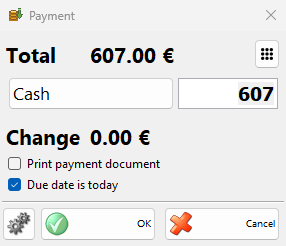
A sale uses the same window (see Sale). The amount is filled in with the total, or with zero if Default payment amount: is Zero. What you do not pay stays due to the supplier.
If the amount is less than the total, the program asks “The paid amount is less than the total. Do you want to add another payment?”. Yes adds this payment so you can enter another one. No saves with the rest due. Ask to add a payment if the operation is not fully paid turns the question off.
| Option | What it does |
|---|---|
| Due Date, Remaining Days, Due date is today | Set when the unpaid part is due. The date cannot be earlier than the date of the purchase. |
| Use payments owed to us | Pays the purchase with money the partner owes you. Hidden by default: turn it on with the Settings button of the window. |
| Print cash receipt | Shown with an enabled cash receipt printer. Registers the cash paid as a withdrawal on the device. |
Drafts
A draft keeps an unfinished purchase. It does not change the stock or the prices and creates no payments. Save draft appears when you close a window with valid unsaved rows. To continue, select the draft in Reports → Drafts… and use Actions → Edit. The window then shows “Edit purchase draft”, and saving turns the draft into a normal purchase.
Transform the purchase
For a new purchase click Actions → Save and Transform and confirm. The purchase is saved first, with its payment, and then you choose the destination document. Saved purchases are transformed with Operations → Transform Document… (Ctrl+T), which can also create a purchase from a purchase order. See Transform Document.
Troubleshooting
| Problem | Solution |
|---|---|
| “Opening the Purchase screen is not allowed!” | Ask an administrator to allow Purchase for your user in Edit → Administration → Permissions…. |
| “This operation is not available because the purchase prices are hidden for the current user…” | Ask an administrator to select Show items purchase price for your user in Edit → Users…. |
| “There are no valid rows in the purchase document!” | Add at least one item with a quantity greater than zero. |
| “The purchase price of item “…” is zero. You are not allowed to use zero prices!…” | Enter a price, or select Allow sales using zero prices for the user. It also applies to purchases. |
| “The sale price you entered for … is lower than its purchase price…” | Yes keeps the price. Do not warn me anymore or Warn if the sale price is lower than the purchase price in Tools → Settings… → Special turns the warning off. |
| “Item … has already been involved in a stock-taking…” | A warning for a purchase dated before a stock-taking. Check the date. You can continue. |
FAQ
Can I save a purchase that is not paid yet?
Yes. Set the amount to 0 in the Payment window.
Why did the sale price of an item change after a purchase?
A value changed in the Sale price column is saved to the item.
Related pages
- Edit purchases (Edit → Documents → Purchase…, Ctrl+F3). Changing sale prices there requires Edit Sale Prices In Saved Purchases, which operators do not have by default.
- Reprint Purchase (Ctrl+Shift+F3)
- Purchases report
- Purchase Return
- Payments
- Recalculate purchase prices
- Items