
A purchase order is the list of items you want to buy from a supplier, with the quantities and the purchase prices you expect. You print it or send it to the supplier. Saving a purchase order does not change the stock, the item prices or the payments. When the goods arrive, you transform the purchase order into a Purchase, which receives them into stock.
License required. The Purchase Order operation is part of the paid Advanced Operations module. Without a license the window opens with a warning, but saving is blocked with the message “This is a free version of the Purchase Order operation! To save your operation please purchase a license.”
Open the Purchase Order window
Go to Operations → Management → Purchase Order or press Ctrl+Alt+F8. If your user has no permission for this menu item, the program shows “Opening the Purchase Order screen is not allowed!”. The window also needs the purchase prices: if Show items purchase price is cleared for your user in Users, the program shows “This operation is not available because the purchase prices are hidden for the current user…” and the window does not open.
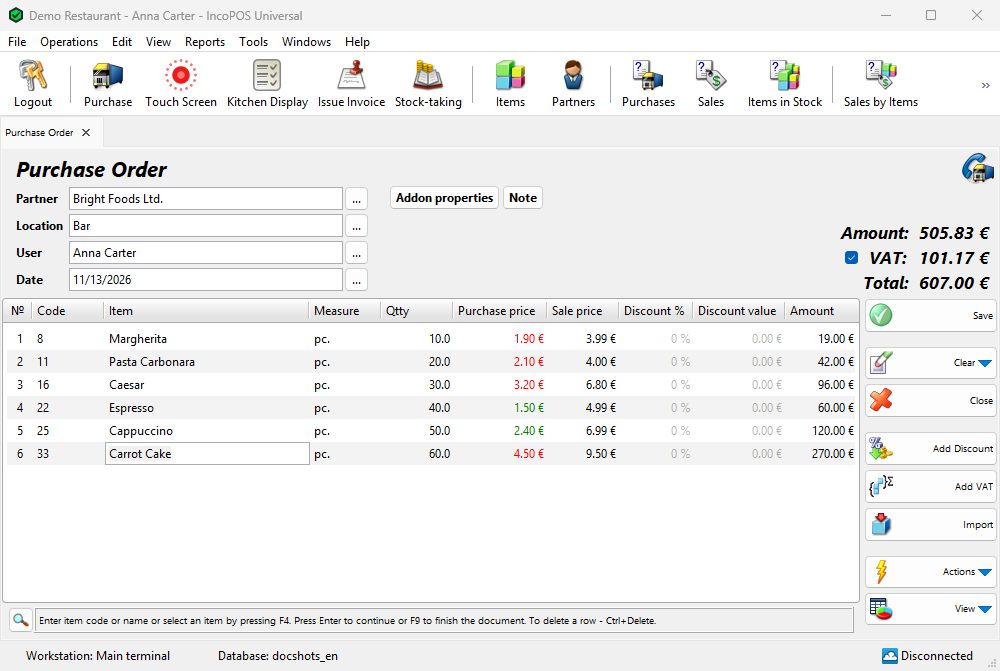
Fill in the header
In each header field type a name or code and press Enter, or open the list with F4, a double-click in the field or the … button.
| Field | What to enter |
|---|---|
| Partner | The supplier you order from. Required. Your user’s default partner is filled in, if there is one. A VAT exempt partner makes the document VAT exempt. |
| Location | The location the goods are ordered for. Required. Its stock does not change. Your user’s default location is filled in, or the only location if there is just one. |
| User | The user responsible for the document. The logged-in user is filled in. |
| Date | The document date. Today is filled in. Press F4 or double-click to use the calendar. |
Changing the user or the date requires the Edit User or Edit Date permission (Operations), which operators do not have by default.
Add items
- In the Item column type the item name, code or barcode and press Enter. To choose from the list, press F4 or double-click the cell. In the list you can select several items with Ctrl+click, or with Shift and the arrow keys.
- In the Qtty column enter the quantity you order and press Enter.
- In the Purchase price column check or change the supplier’s price and press Enter.
- In the Sale price column check or change the price and press Enter. Enter moves through the remaining editable columns and opens a new row after the last one.
- Repeat for each item. To delete the current row press Ctrl+Delete.
The quantity is not checked against the stock. Purchase orders do not use lots: there are no lot, serial number, expiration date, production date or lot location columns.
| Column | Meaning |
|---|---|
| Purchase price | The item’s current purchase price is filled in. With Use last purchase price by default in purchases in Tools → Settings… → Operations, the price and the discount of the item’s last purchase are filled in instead. |
| Markup % | The profit as a percentage of the purchase price. Entering a value recalculates the sale price. Shown with Enable markup in the settings. |
| Sale price | The item’s price for the price group of the partner and the location. It is saved with the purchase order only and does not change the item. |
| Discount %, Discount value | A discount from the supplier for the row. Shown only when Allow percent discounts or Allow value discounts is enabled in the settings. |
| Amount | Quantity × purchase price after the discount. |
The totals Amount:, VAT: and Total: are shown at the top right and are based on the purchase prices. Clearing the check box next to VAT: makes the whole document VAT exempt after a confirmation. Price rules that apply to purchase orders can change the rows; the program then shows “Price rule applied”.
Colors and price warnings
- Purchase price is red if it is higher than the item’s last purchase price and green if it is lower.
- Sale price is red if it is lower than the purchase price or if the item is in a promotion.
- Item is orange if the same item is already on an earlier row. This is only a warning.
If the sale price of a row would be lower than its purchase price, the program asks “The sale price you entered for … is lower than its purchase price. Do you want to continue?”. Yes keeps the price, and Do not warn me anymore turns the question off. It is also controlled by Warn if the sale price is lower than the purchase price in Tools → Settings… → Special.
Buttons
| Button | What it does |
|---|---|
| Save (F9) | Saves the purchase order (see Save and print). |
| Clear | Its menu has Delete current row and Delete all rows. |
| Close (Esc) | Closes the window. If there are unsaved rows, the program asks “Exit without saving the purchase order?”. |
| Add Discount (Ctrl+Shift+D) | Spreads a percent or value discount for the whole document over the rows. Shown only when discounts are allowed in the settings. |
| Add VAT / Subtract VAT | Recalculates the entered prices. Add VAT is shown when the program works with prices with VAT included: use it if you entered prices without VAT. Subtract VAT is the opposite. After a click the button switches, so you can undo it. |
| Import | Loads the item rows from a file, as in Proforma Invoice. Shown only when data importers are available. Fill in the header first. |
| Actions | For a new purchase order it has Save and Transform (see Transform the purchase order). |
| View | Addon properties… chooses the additional properties of purchase orders, for example Status, and Context panels… the panels shown with the document. Shown only to users with the Change Addon Properties or Change Context Panels permission, which operators do not have by default. |
| Note, Addon properties | Tabs next to the header for a note and additional document properties. |
Save and print
- Press F9 or click Save. The program asks “Do you want to save the operation?”.
- Click OK to save. Click Save draft to keep the document as a draft instead (see below).
- If printing is available, the program asks “Do you want to print a purchase order?”. Yes opens the print preview and Don’t ask me again remembers the answer. The question depends on Print documents: in Tools → Settings… → Printing.
After saving, the window is cleared for the next purchase order. The printed document is described in Reprint Purchase Order.
Drafts
A draft keeps an unfinished purchase order for later; it gets a document number only when you save it. Save draft appears when you save a new document and when you close a window with unsaved rows. To continue, select the draft in Reports → Drafts… and use Actions → Edit. The window then shows “Edit purchase order draft”, and saving it with OK turns the draft into a normal purchase order.
Transform the purchase order
When the goods arrive, transform the purchase order into a purchase instead of typing the rows again:
- Go to Operations → Transform Document… (Ctrl+T) and select the purchase order, or select it in the Purchase Order – Select Document window of Edit Purchase Order and click Actions → Transform Selected Documents.
- In Transformation – Select Destination Document choose Purchase and click OK. With Use prices from the source document the purchase prices of the order are kept. Annul the source document annuls the purchase order after the purchase is saved. Use the date from the source document keeps its date instead of today.
- The Purchase window opens with the rows. Change the quantities to what you really received and save it there, with its payment.
Several selected purchase orders are combined into one document. A purchase order that is not annulled stays in the list, and Actions → Related Documents shows the purchase made from it. For a new purchase order, Actions → Save and Transform saves it first and then asks for the destination document. A purchase order can also become another document, for example a Transfer. See Transform Document.
Purchase orders from the Purchase Planner
Operations → Management → Purchase Planner calculates which items to order from the sales and the stock. Its Purchase Order button opens a new purchase order with these items, which you check and save as above. This button requires a Pro license. With Treat purchase orders as delivered, the planner counts the quantities of saved purchase orders with the selected statuses as already received.
Troubleshooting
| Problem | Solution |
|---|---|
| “This is a free version of the Purchase Order operation! To save your operation please purchase a license.” | Activate a license for IncoPOS. The free version cannot save purchase orders. |
| “Opening the Purchase Order screen is not allowed!” | Ask an administrator to allow Purchase Order for your user in Edit → Administration → Permissions…. |
| “This operation is not available because the purchase prices are hidden for the current user…” | Ask an administrator to select Show items purchase price for your user. |
| “There are no valid rows in the purchase order document!” | Add at least one item with a quantity greater than zero. |
| There is no Add Discount button or discount column. | Enable Allow percent discounts or Allow value discounts in Tools → Settings… → Operations. |
FAQ
Does a purchase order change the stock or the prices?
No. Only the purchase made from it adds the quantities to the stock and updates the item prices.
Can I order items I already have in stock?
Yes. The availability is not checked.
How do I remove a purchase order that was delivered?
Select Annul the source document when you transform it, or annul it later in Edit Purchase Order.
Related pages
- Edit Purchase Order (Edit → Documents → Management → Purchase Order…)
- Reprint Purchase Order (Edit → Reprint Documents → Management → Purchase Order…)
- Purchase
- Transform Document
- Reports → Management → Purchase Orders…, see Management reports