
A consignment gives items to a partner who sells them for you. Saving it decreases the quantities in the selected location and records which items the partner holds and at what prices. It creates no payment and changes no item prices. The money is recorded later, when you enter what the partner sold.
Consignment is part of the paid Advanced Operations module. Without a license you can fill in the document but not save it.
How consignments work
| Document | When to use it | What it does |
|---|---|---|
| Consignment (F6) | The partner takes the items. | The quantities leave the location. No payment is recorded. |
| Consignment Sale (Ctrl+F6) | The partner reports what was sold. | Records the sale and its payment. The stock does not change again. |
| Consignment Return (Alt+F6) | The partner brings back unsold items. | The quantities return to the location. |
Both documents start from a saved consignment, keep its prices and accept only the quantities that remain, so you can close a consignment in several steps.
Open the Consignment window
Go to Operations → Consignments → Consignment or press F6. Unless stated otherwise, the settings named on this page are in Tools → Settings… → Operations.
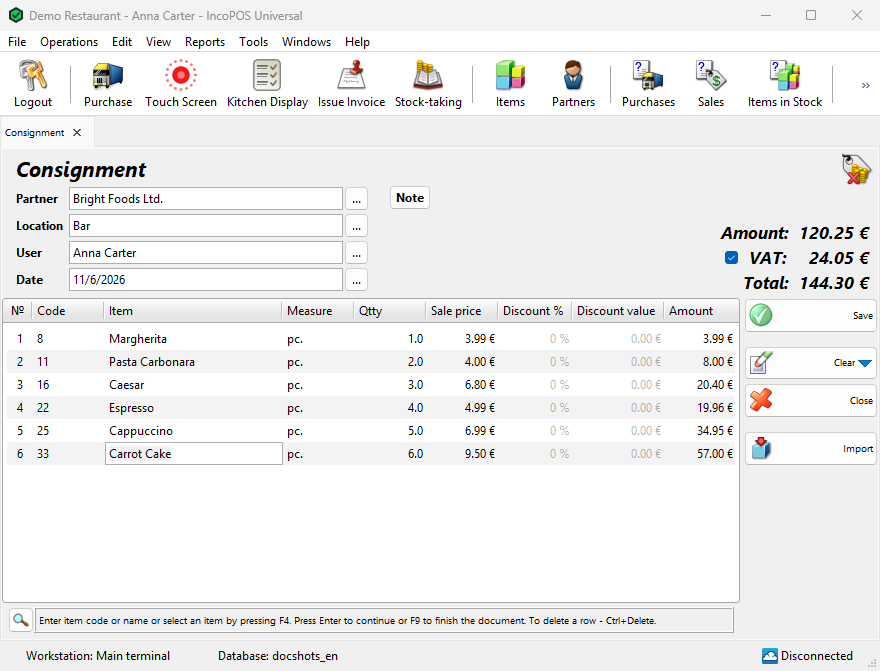
Fill in the header
In each header field type a name or code and press Enter, or open the list with F4, a double-click in the field or the … button.
| Field | What to enter |
|---|---|
| Partner | The partner who takes the items. This field is required. Your user’s default partner is filled in, if there is one. The prices follow the partner’s price group. A VAT exempt partner makes the document VAT exempt. |
| Location | The location the items leave. Its price group can also affect the prices. It is filled in if your user has a default location or if there is only one. |
| User | The logged-in user is filled in. |
| Date | Today is filled in. Press F4 or double-click to pick a date from the calendar. |
Changing the user or the date requires the Edit User or Edit Date permission (Operations), which operators do not have by default.
Add items
- In the Item column type the item name, code or barcode and press Enter. To choose from the list, press F4 or double-click the cell. In the list you can select several items with Ctrl+click, or with Shift and the arrow keys.
- In the Qtty column enter the quantity and press Enter. To read the weight from a connected electronic scale, press Ctrl+F.
- In the Sale price column check or change the price and press Enter. Enter moves through the remaining editable columns and opens a new row after the last one.
- Repeat for each item. To delete the current row press Ctrl+Delete.
When you enter a barcode, the row gets a quantity of 1 and the cursor moves to a new row. Entering the same barcode again increases the quantity of that row. To enter the quantity with the code, use an asterisk in the Item column, for example 3*1234.
| Column | Meaning |
|---|---|
| Sale price | The price of the item for the partner, filled in from the price group of the partner and the location. A new price here applies only to this consignment and is not saved to the item. |
| Discount %, Discount value | A discount for the row. Shown only when Allow percent discounts or Allow value discounts is enabled and your user has the Make Percent Discounts or Make Value Discounts permission. |
| Amount | Quantity × price after the discount. Editable with Enable totals edit. |
| Code, Markup % | Shown with Enable item code and Enable markup. Entering a Markup % recalculates the Sale price. |
The totals Amount:, VAT: and Total: are shown at the top right. Clearing the check box next to VAT: makes the whole document VAT exempt after a confirmation. Price rules that apply to consignments can change the rows. The program then shows “Price rule applied”.
Availability
If the location does not have enough quantity, the Qtty cell is highlighted and the consignment cannot be saved. To go below zero, select Work with negative availability. Items marked Non-inventory or service are not checked. Auto production does not produce items for a consignment, so they must be in stock.
Lots
A consignment takes its quantities from lots the same way as a Sale: you cannot type in the lot columns, the quantity follows the method in Item management:, and a row is split when one lot does not have enough. Consignment Sale and Consignment Return keep the lot of each consignment row.
Buttons
| Button | What it does |
|---|---|
| Clear | Its menu has Delete current row and Delete all rows. |
| Close (Esc) | Closes the window. If there are unsaved rows, the program asks “Exit without saving the consignment?” (see Drafts). |
| Import | Loads the rows from a file, as in Purchase. Shown when data importers are available. Fill in the header first. |
| Note | A tab next to the header for a note to the document. |
Save and print
- Press F9 or click Save. If price rules ask for a confirmation, click Apply in the Confirm Price Rules window.
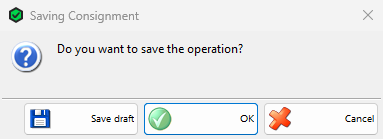
- The program asks “Do you want to save the operation?”. OK saves the consignment and Cancel returns to it.
- If printing is available, the program asks “Do you want to print a consignment?”. Yes opens the print preview of the Protocol for Consignment of Items and Don’t ask me again remembers the answer. The question depends on Print documents: in Tools → Settings… → Printing.
The rows are then cleared for the next consignment. The partner and the location stay filled in.
Drafts
A draft keeps an unfinished consignment. It does not change the stock. Save draft is in the save question and, with valid rows, in the question shown when you close the window. To continue, select the draft in Reports → Drafts… and use Actions → Edit. The window then shows “Edit consignment draft”, and saving turns the draft into a normal consignment.
Create another document from a consignment
A new consignment has no Save and Transform, Operations → Transform Document… does not list consignments, and no document can be transformed into a consignment.
To copy the rows of a saved consignment to another document, go to Edit → Documents → Consignments → Consignment…, select it and use Actions → Transform Selected Documents. This requires the Transform Unprocessed Operations permission, which operators do not have by default. See Transform Document.
The quantities that the partner holds do not change, and a Sale made this way decreases the stock a second time. To record what the partner sold, use Consignment Sale.
Troubleshooting
| Problem | Solution |
|---|---|
| Consignment is not in the Operations menu | Ask an administrator to allow Consignment for your user in Edit → Administration → Permissions…. |
| “This is a free version of the Consignment operation! To save your operation please purchase a license.” | Add a license that includes the Advanced Operations module. |
| Saving only moves the cursor to Partner | The field is empty or no partner has that name or code. Select a partner. |
| “There are no valid rows in the consignment document!” | Add at least one item. |
| “The consignment cannot be saved due to insufficient availability of item “…”.” | Lower the quantity or enter a Purchase. In a saved consignment, a row cannot go below the quantity already sold or returned. |
| “The sale price of item “…” is zero. You are not allowed to use zero prices!…” | Enter a price, or ask an administrator to select Allow sales using zero prices for your user in Edit → Users…. |
| “The sale price you entered for … is lower than its purchase price…” | Yes keeps the price. Do not warn me anymore or Warn if the sale price is lower than the purchase price in Tools → Settings… → Special turns the warning off. |
| “You don’t have permission to make discounts or corrections to the operation!” | Lowering a quantity, deleting a row, replacing an item or raising a discount requires Make Corrections In Operations or Make Corrections In New Operations. A user with one of them can log in after the message to allow the change. |
| “Item … has already been involved in a stock-taking…” | A warning for a consignment dated before a stock-taking. Check the date. You can continue. |
FAQ
What is the difference between a consignment and a sale?
Both take the items out of stock. A Sale records the payment at once. A consignment records only what the partner holds, and the payment comes with the Consignment Sale.
Does the partner owe me money after a consignment?
Not in Payments: a consignment creates no due amount there. The value of the items that the partner still holds is shown in Reports → Consignments → Consignees’ Debt….
How do I see what a partner still holds?
Use Reports → Consignments → Consignments Flow…. It shows the consigned, sold, returned and remaining quantities and amounts.
Related pages
- Consignment Sale
- Consignment Return
- Edit consignment (Edit → Documents → Consignments → Consignment…)
- Reprint Consignment
- Consignments report (Reports → Consignments → Consignments…)
- Consignments Flow report
- Consignees’ Debt report
- Write-off
- Items